I close my eyes to the fabrications…
10 IMAGES in support of fayen d’evie’s proposal to CREATIVE AUSTRALIA
ARTS and disability initiative
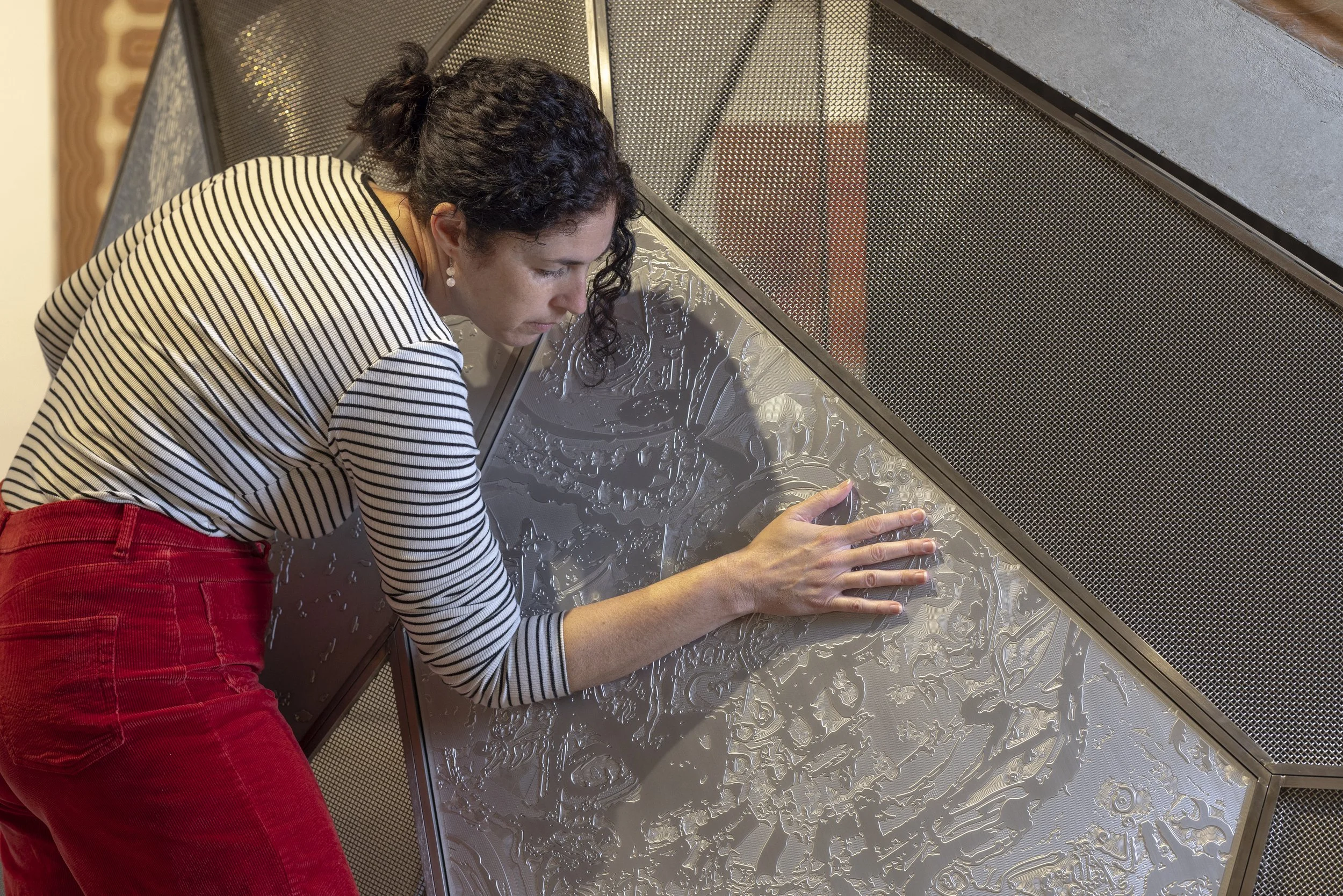
IMAGE DESCRIPTION: A woman wearing a striped long-sleeved shirt tucked into jewel-toned red pants is leaning over, touching an engraved aluminium panel from Fayen d’Evie’s architectural sculpture ( reflecting air ) “…Touch enabled her to discern minute details… which often pass unnoticed…” (2025). The woman’s palm and forearm are flat against the surface of a tactile translation of an excerpt of John Olsen’s ceiling painting, The Sea Sun of 5 bells (1964). Around the tactile aluminium panels, the sculpture is fabricated from a sparkling stainless steel mesh veil, that both reveals and obscures partial views of the surrounding gallery. Photo by Edwina Richards.
RELEVANCE: This is included as an example of my capacity to research and experiment with methods for introducing tactility into sculptural installations oriented through blindness.
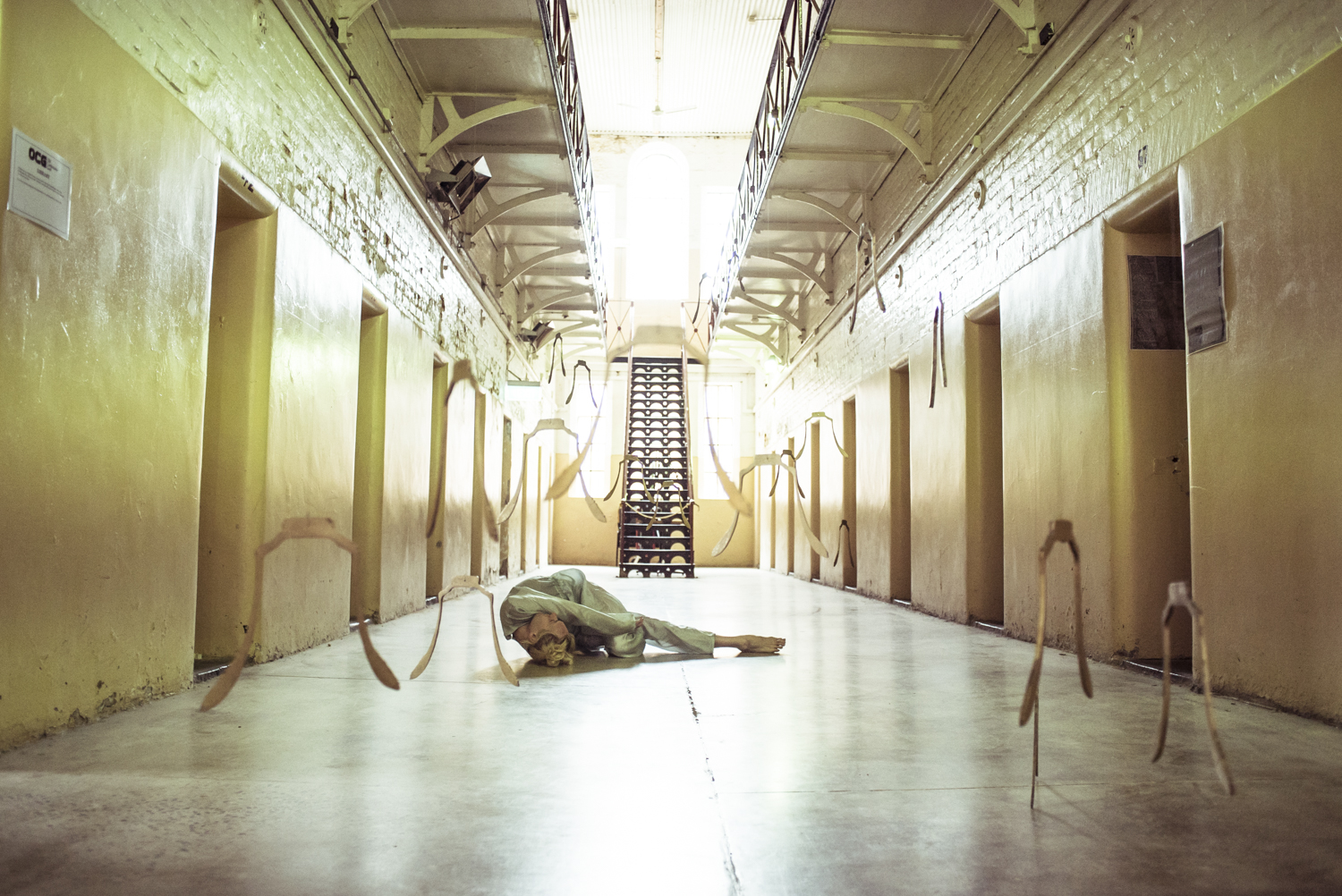
IMAGE DESCRIPTION: In a corridor of the Old Castlemaine Gaol, a historic Victorian prison, dancer Benjamin Hancock draped in a diaphanous pale green fabric, lies circled into an improbably shape, head tucked under his torso, one leg outstretched. In the foreground, skeletal bell shapes cast by blind sculptor Aaron Mcpeake hang, installed by Fayen d’Evie as a cloud of resonant bells, such that they swayed in the wind currents. Documentation of From Dust to Dust: Prologue (2018). Photo by Pippa Samaya.
RELEVANCE: This is included as an example of my long-term interest in revisiting colonial histories of the discipline and control of bodies through contemporary sculptural and performative activations. In this case, I staged two developments within the Old Castlemaine Gaol, attended by invited audiences; hybrid artist-curatorial projects that explored the potential for creative methods generated through blindness and Deafness to subvert architectures designed for sensory segregation and deprivation.

IMAGE DESCRIPTION: In a dark studio, a wide strip of grey, vinyl, tarkett flooring creates a linear path for a performance. Semi-transparent organza drapes in shimmering pink and purple and green have been suspended so that they hang over the tarkett. Their hems are threaded with pale rope. A pink drape with indecipherable lettering tacked on rests on the tarkett, its rope sprawling across the floor. Two other drapes have been pulled back, and tied off with rope, so that they create a soft awning. On the right hand side, four plastic fans have been mounted in a linear column. Television screens glow from the dark reaches of the studio, paused on an image of bats flying across a cityscape. Photo by Jon Tjhia.
RELEVANCE: This is documentation of the ‘Language of Lunacy’ development in late 2025, where Jon Tjhia and I first began to test Poppy Levinson’s concept of a fan as a sensorial wayfinding devices for blind performers, and where I discovered the potential for the fans to also offer a method of performative activation in the absence of bodies. It is included to give background to where the current project idea comes from, and to demonstrate we undertook some initial trials with programming fans with Q-lab as a staging and installation strategy.

IMAGE DESCRIPTION: Within a dark theatre, Fayen d’Evie stands, cane raised so that it rests on her left palm, on a circular, tactile shape, under a bright spotlight that stands out against the dim, red-bathed stage. She is wearing a loose robe patterned in an abstract swirl of burgundy, purple and mint green. Behind her, two screens mounted side by side display a caption [controlled hover, sparkles of starlight]. To the left, Hard-of-Hearing sound artist and composer Rebecca Bracewell sits on a low platform, twisting dials, her laptop open. In the foreground, a body lays, barely visible. Documentation from a live performance of ~~~~~ “...derelict in uncharted space...” (2023). Photo by Gianna Rizzo.
RELEVANCE: This is included as an example of my experience integrating access into a performative setting. I integrated two layers of captions into the staging concept for this performance, including pre-recorded and live captioning. Note that the stage play incorporated a group of community audiodescribers, led by Jon Tjhia. This demonstrates our experience in collaborating on developing access elements of a major exhibition or performance; experience we will carry into the proposed project.
![ITEM DESCRIPTION: Photographic documentation of a participatory performance 'Tactile Dialogues [Shared Action]' 2016, which I enacted in Moscow, alongside Deaf Blind poet Irina Povolotskaya, as part of the exhibition Human Commonalities, V.A.C. and …](https://images.squarespace-cdn.com/content/v1/582f8346ff7c5046969a1473/1523841041369-ZE47HMQS7ED6CP6FJW3D/25.jpg)
IMAGE DESCRIPTION: Photographic documentation of my participatory performance 'Tactile Dialogues [Shared Action]' 2016, which I enacted in Moscow, alongside Deaf Blind poet Irina Povolotskaya, as part of the exhibition Human Commonalities, V.A.C. and the State Museum of Vadim Sidur. This image shows three people - a local artist, one of the V.A.C. staff, and the Australian ambassador to Russia - leaning in to feel the undulations of avant garde artist Vadim Sidur’s Structure #1.
RELEVANCE: Provides an example of my sustained commitment over the past decade to developing scores for audiences to encounter artworks through tactility and other senses. I wrote a detailed account of the score used for this performance in a journal article, accessible at the following link:
“Orienting Through Blindness: Blundering, Be-Holding and Wayfinding as Artistic and Curatorial Methods,” Performance Paradigm, Issue 13, 2017.

IMAGE DESCRIPTION: A staff member of SAMSTAG Museum of Art, Anna Zagala, holds a tactile acrylic print, her thumbs touching a shape that correlates with gestural typography in a framed screenprint installed on the wall in front of her. The gestural typography on the screenprint and the tactile print are translations of the phrase “Care is a cognate to grief.” The typography is a stylised version of my orthographic translation of Deaf dancer Anna Seymour signing this phrase in Auslan-based gestural poetics.
RELEVANCE: This image is documentation from my exhibition Endnote: The Ethical Handling of Empty Spaces, presented as part of the Adelaide//International at SAMSTAG Museum of Art, Adelaide, 2021. The tactile acrylic print was made in collaboration with Vision Australia. It is included to show my commitment to experimenting creatively with methods for expanding access to artworks.

IMAGE DESCRIPTION: A page spread in greyscale from a performative publication, Care is a cognate to grief (2020), which is a collaborative project I co-developed with archivist and designer Lizzie Boon and conservator Sofia Lo Bianco. The spread is extracted from a video reading, commissioned by Shimmer x PUBLICS, Rotterdam/Helsinki, in which I narrated our co-authored text, as the pages flipped. This video reading was an experiment in offering Deaf audiences a more compelling way of accessing narrated information than via standard captions. The image on the left hand side of the spread shows a granite sculpture that I created, sitting outside my then home on Djaara country, prior to it being freighted for exhibition. A small hand is reaching from behind.
RELEVANCE: This image is included to show an example of how I have approached a sculptural surface as a page in which to embed text; in this case, the granite sculpture was the page, into which I inserted bronze braille, and also excavated tactile punctuation marks by chiselling. The text on the right hand page offers an example of my interest in weaving imagery and text, and demonstrates my ongoing experiments with unconventional publishing. I have also selected this image to point to my interest in thinking conceptually, critically, culturally and discursively in relation to artworks, including foregrounding histories of handling that are usually unseen by audiences. For ‘I close my eyes to the fabrications…’, I have been imagining possibilities to introduce scores to activate the sensory installation via unconventional publication, that integrates poetic references to some of the archival discoveries of the fabrication and wear of straitjackets, and excerpts from the fictional texts.

IMAGE DESCRIPTION: A group of children and two artist educators from the Museum of Contemporary Art (MCA), Sydney, gather around a blue, floor-mounted sculpture; many of the children are touching the sculpture with their hands. A second blue sculpture is suspended above them. Some of the children are wearing blue tunics. The image is drawn from documentation of one of the public programme activities developed for my Bella Room commission at the MCA, With Cane in Hand, I Dance a Duet for One, for Two, for Three, for Four (2022).
RELEVANCE: This image is offered as an example of my commitment to working with museum staff, where invited, to develop sensory scores that can be adapted and tailored for a variety of audiences. In this case, the children decorated blue costumes, then danced and made music as they paraded through the MCA, effectively creating movement and sounding sculptures. In relation to ‘I close my eyes to the fabrications…’, the project includes a commitment from Science Gallery staff to be in conversation about possibilities for the gallery to adapt and tailor the installation and scores for varied public audiences.

IMAGE DESCRIPTION: Two women stand with their backs to the camera, partially obscuring carved, granite paintings mounted on the wall in front of them. Each painting has a contact microphone attached, and each woman is wearing headphones. They are both touching the paintings. The image is drawn from documentation of an installation at the Incinerator gallery, Melbourne, of tactile and audible granite paintings, which I titled Reading ‘Sequence’ / Tactile Re-call (2018). The compositions of the paintings relate to my memories of walking within and around the sculpture Sequence by Richard Serra, which was installed in SFMOMA.
RELEVANCE: This image is provided as an example of a past work that offered varied perceptual ways of engaging with an artwork. Not visible in the image is a paired sound work, Wayfinding ‘Sequence’ / Vibrational Re-call (2018) that used ultradirectional speakers to bounce an audio collage around the gallery. The audio collage consisted of wayfinding recordings of Georgina Kleege navigating Sequence by Richard Serra, using her mobility cane to shoreline the walls of the sculpture. One of the research components of ‘I close my eyes to the fabrications..’ will involve considering audio elements that might offer an additional perceptual dimension to the work, possibly integrated into experiments with the potential for the fictional stories to be incorporated via captioned audio-video screens/projections.

IMAGE DESCRIPTION: A man, actor Ben Phillips, is cradled within a damp rawhide form, suspended from steel cables. His eyes are closed, and his hands are at rest on his chest. The image is drawn from documentation of a private performative session, in which I invited two blind collaborators, Ben Phillips and Janaleen Wolfe, to be the first visitors to a tactile exhibition opening the next day. The exhibtion was From One Body to Another. Sophie Takách and Fayen d'Evie, with Janaleen Wolfe, Ben Phillips and Bryan Phillips. Casula Powerhouse, Sydney, 29 Apr – 2 Jul 2017. Photo by Pippa Samaya.
RELEVANCE: This is included as an example of a previous collaborative installation project, in this instance, working with sculptor Sophie Takách, who conceived of the mechanisms for attaching and suspending rawhides, and with actors from the Theatre of the Blind who shaped the works through embodied engagement. There are parallels with ‘I close my eyes to the fabrications..’ Firstly, I will collaborate with costumier Lillian Hull, who is able to analyse the construction techniques, and interpret fabrication histories, bringing expertise that is different and complementary to my creative experience. Secondly, through the mentorship with Joseph Rizzo Naudi, I am again reaching out to a blind collaborator to help shape the installation - this time, shaping language rather than rawhides.